CPR classes available 7 days a week. Same-day certification.

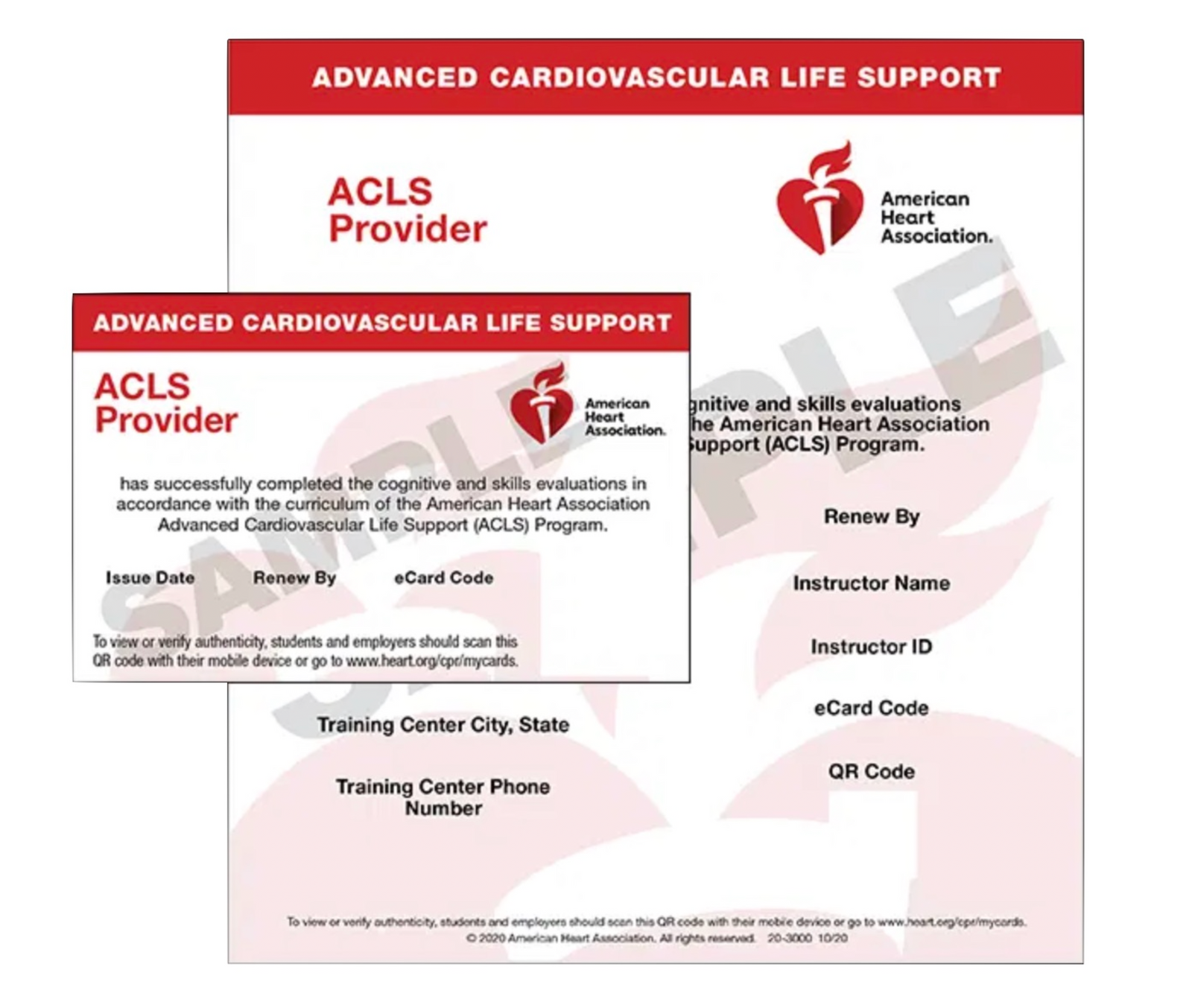
Advanced Cardiovascular Life Support (ACLS)
**includes Basic Life Support (BLS) for Healthcare Providers
Official certification through American Heart Association (AHA)
FORMAT
BLENDED. The online component is free. It must be completed at least 1 week prior to class or class may be canceled. Details below.
SELF-PREPARATION
Give yourself about a month to prepare for class.
PAYMENT
$140 cash (during class) or $160 electronic payment (during registration)
REQUIRED PROVIDER MANUAL
AHA mandates that students have a 2025 AHA ACLS Provider Manual prior to, during, and after class.
Students are required to read their manual prior to class. Successful completion of class is dependent on a firm understanding of the content in the manual. There will be content that we test on that will not be covered in class. Please use the precourse work to identify gaps in your knowledge and remediate these gaps PRIOR to class.
All testing scenarios can be found in the Appendix of the provider manual. Please review the Appendix to become familiar with the AHA's testing criteria prior to coming to class.
If you need to borrow a book please email Maria at CPRmobile.me@gmail.com to arrange pickup at The Commerce Center Books are loaned to students who have submitted payment.
BRING TO CLASS
Bring a snack and your Provider Manual
LOCATION
The Commerce Center, 1099 Gum Branch Rd, Jacksonville, NC 28540. Arrive early and wait in the lobby.
Classes start on-time; please arrive early enough to allow yourself time to get settled in.
Generally offered the first Sunday and first Tuesday of each month
Online Component
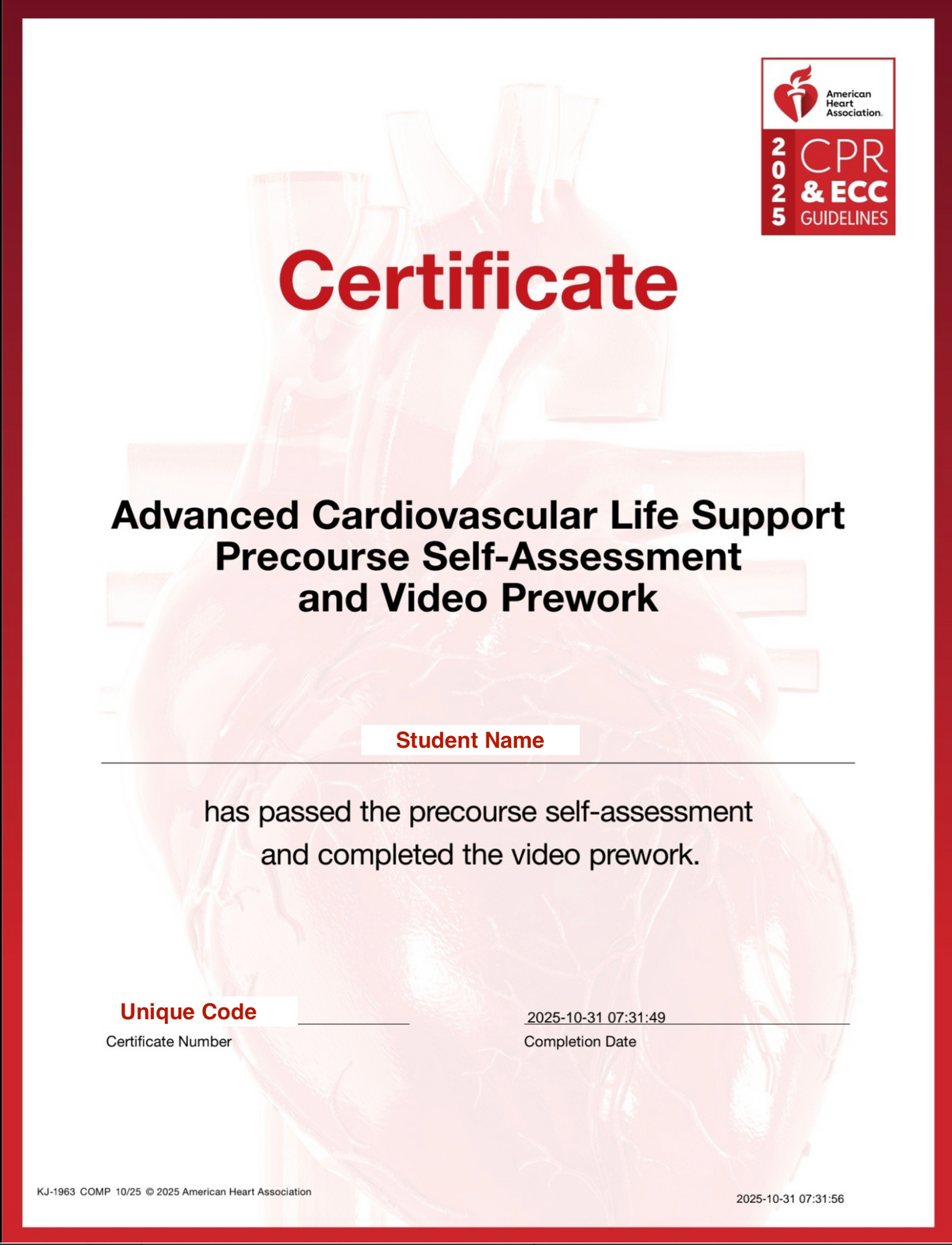
Submit this certificate at least 1 week prior to class to avoid losing your seat or having class canceled.
Complete your online components through the AHA website:
https://shopcpr.heart.org/acls-prework.
PRECOURSE SELF-ASSESSMENT: 50-question quiz. Use your feedback for self-remediation prior to class. It is recommended to be able to score >90% for each topic.
VIDEOS: about 4 hours of videos/questions. Once completed, you will need to complete a survey for it to generate a certificate (see example).
Please use the precourse work to identify gaps in your knowledge and remediate these gaps PRIOR to class.
NOTES
If you are having issues accessing your certificate, it is likely because you haven't complete AHA's survey at the end. Log back into https://elearning.heart.org to access your course and complete all prompts.
DO NOT make any purchases through the AHA website. These online components are free.
The AHA website(s) can be difficult to navigate. Please email Maria at CPRmobile.me@gmail.com if you run into issues accessing any portion of your online work.
IN CLASS STRUCTURE, SKILLS, & TOPICS
BLS REVIEW
Relief of choking for conscious and unconscious patients
CPR and AED as a single-rescuer and as part of a multi-rescuer team
"Rescue Breaths" for respiratory failure
Drowning
Opioid overdoses
ACLS CODE
Rapid Manual Defibrillation
Precharging the monitor and pre-checking a pulse
Recognizing shockable vs non-shockable rhythms (compressions must not be interrupted for more than 10 seconds when doing this)
IV/IO access
Medications for cardiac arrest
Simple airway adjuncts
H&T's - especially how they relate to PEA
SYMPTOMATIC BRADYCARDIA
Treat reversible causes, indicate medications, and transcutaneous pacing
Differentiate between stable and unstable
Understand indications for transcutaneous pacing
Demonstrate transcutaneous pacing
SYMPTOMATIC TACHYCARDIA
Treat reversible causes, vagal maneuvers, indicate medications, and synchronized cardioversion
Differentiate between stable and unstable
Understand the indications for synchronized cardioversion
Demonstrate synchronized cardioversion
MEGACODE
Manage a patient (manikin) that starts with symptomatic bradycardia/tachycardia and goes into cardiac arrest
Successfully play the role of a Team Leader
Successfully play the role of a Team Member
AIRWAY MANAGEMENT
Rescue breaths and simple airway adjuncts (NPA/OPA)
Indications for advanced airways
WRITTEN EXAM >84%
Open notes/AHA resources
Consider bringing your reading glasses
REMEDIATION
Insufficient SELF-remediation often results in the need for CLASSROOM-remediation. If the student is not able to demonstrate proficiency by the AHA standards, the student will not be issued a certification and there will be no refund. The instructor will provide the student a checklist of proficiency criteria that need remediation. Please be familiar with the Appendix (testing criteria) of your provider manual.
The student is expected to self-remediate (aka study) for a minimum of 2 weeks prior to attempting another class.
The student must re-complete both online components. All categories must score >90%.
The student can remediate in the classroom for free (one time) if they are willing to be put on a waiting list (class is capped at 4 students).